AI Is Software. Manage It Like Software.
AI just moved into your business
Most business owners started using AI to chat: draft an email, summarize a document, answer a question. Then the light bulb went on. AI can do far more once it’s connected to your data, your inbox, your files and your business systems. What followed is a land rush. Everyone is racing to wire AI into everything, and everyone feels like they’re already behind.
The excitement makes sense. AI is a superpower for the repetitive digital work we humans stink at, and we use it across Open Tier every day to try to reduce that. But every AI integration is just more software. It has a vendor, a license and a set of permissions, and it can see your information and act on it. Like any software, it needs to be managed by people who understand the tool and where it’s headed.
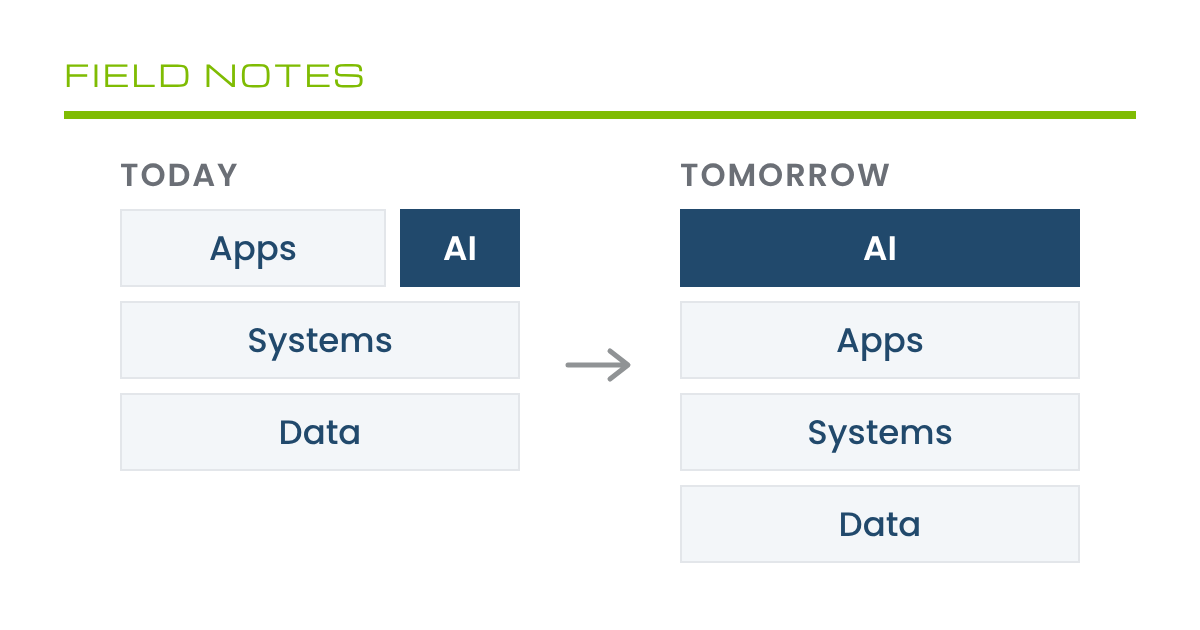
Today: manage it like any other software
Look at how AI shows up in a business today. Copilot runs inside Microsoft 365, a chatbot answers questions on the website, an assistant drafts quotes from the shared drive, and someone has a free tool hooked up to their own mailbox. None of them stay the way you set them up.
- The vendor changes it. Models get updated and retired, and the same instructions start producing different results.
- Your business changes. Owners who sit down to teach AI their processes quickly learn how much lives in their team’s heads. The big processes are easy to describe. The edge cases people handle naturally every day are not, and new ones show up every week. That’s what’s great about people. They relearn and adapt the process on the fly. AI can’t always do that reliably. To be fair, sometimes it adapts better than we do, but you can’t count on which time that will be, and it won’t tell you when what it learned is out of date.
- It acts on whatever it can reach. Connect it to a mailbox or a file share and it uses that access. If the data is messy, it will make mistakes, and it won’t sound unsure about them.
- Nobody owns it. The person who set it up gets busy or leaves, and no one knows what it’s connected to or what it’s allowed to do.
The fix is ordinary IT discipline applied to a new kind of software. Give every AI tool an owner. Keep an inventory of what’s in use and what each tool is connected to, including the free ones people signed up for on their own. Use company accounts and grant only the access each tool needs. Retest after a model update or a process change. And spot-check results on a schedule, because most AI mistakes are quiet, like a wrong number or a skipped step.
Tomorrow: AI becomes the front door
Over the next few years, AI will move from one more tool to the main way your people work with everything else. Instead of opening the CRM, the accounting system and three spreadsheets, they will ask a question in plain English, and AI will pull the answer from all of them. That shift will come faster than past ones, because it builds on the systems you already have instead of replacing them.
Getting there depends on two things most businesses haven’t sorted out yet.
- Data AI can reach. AI can only work through what it can reach. Files on a server in the back closet or a spreadsheet on someone’s laptop are invisible to it. Data in cloud systems is within reach, as long as access is set up securely. More on that in AI Can’t Run What It Can’t Reach.
- Knowing who holds the record. Software vendors see this shift coming, and they’re racing to become your system of record, the platform every AI tool has to go through. That creates lock-in. Keeping your core data in an environment you own, like your own Microsoft 365 or Azure tenant, keeps you in control, though owning it has real costs to secure, back up and run. Either way, know who owns your data and how you would get it out.
It takes people who understand both
Managing AI today and preparing for tomorrow are the same job. The choices you make now about tools, access and vendors decide how ready you’ll be. It shouldn’t be a side project for whoever set up the first chatbot. It takes someone who understands how the software works now and how it will change the way your team works over the next few years.
That’s the work we do with clients. If you’re not sure what AI is running in your business or what it’s connected to, that’s the first question to answer. Schedule an intro call and we’ll walk through it with you.
About The Author